
The European Union has long positioned itself as a global leader in the fight against climate change and the champion of sustainable economic practices. Central to this ambition was the development of a comprehensive sustainable finance framework designed to reorient capital flows towards environmentally responsible activities and to establish a transparent system that would prevent greenwashing. However, recent legislative developments, often grouped under the banner of “simplification,” have led to a significant weakening of this framework. The once-ambitious project is now facing severe criticism from environmental groups, policy experts, and even some market participants who argue that the EU is engaging in a dangerous “race to the bottom” that threatens to dismantle years of careful, science-based policymaking . This article provides a critical analysis of the perceived failures of the EU’s sustainable finance rules, delving into the specific changes made to the Corporate Sustainability Reporting Directive (CSRD), the Corporate Sustainability Due Diligence Directive (CSDDD), the EU Taxonomy, and the Sustainable Finance Disclosure Regulation (SFDR). It explores the consequences of these changes for the environment, the economy, and the EU’s global credibility.
The Genesis of a Green Vision
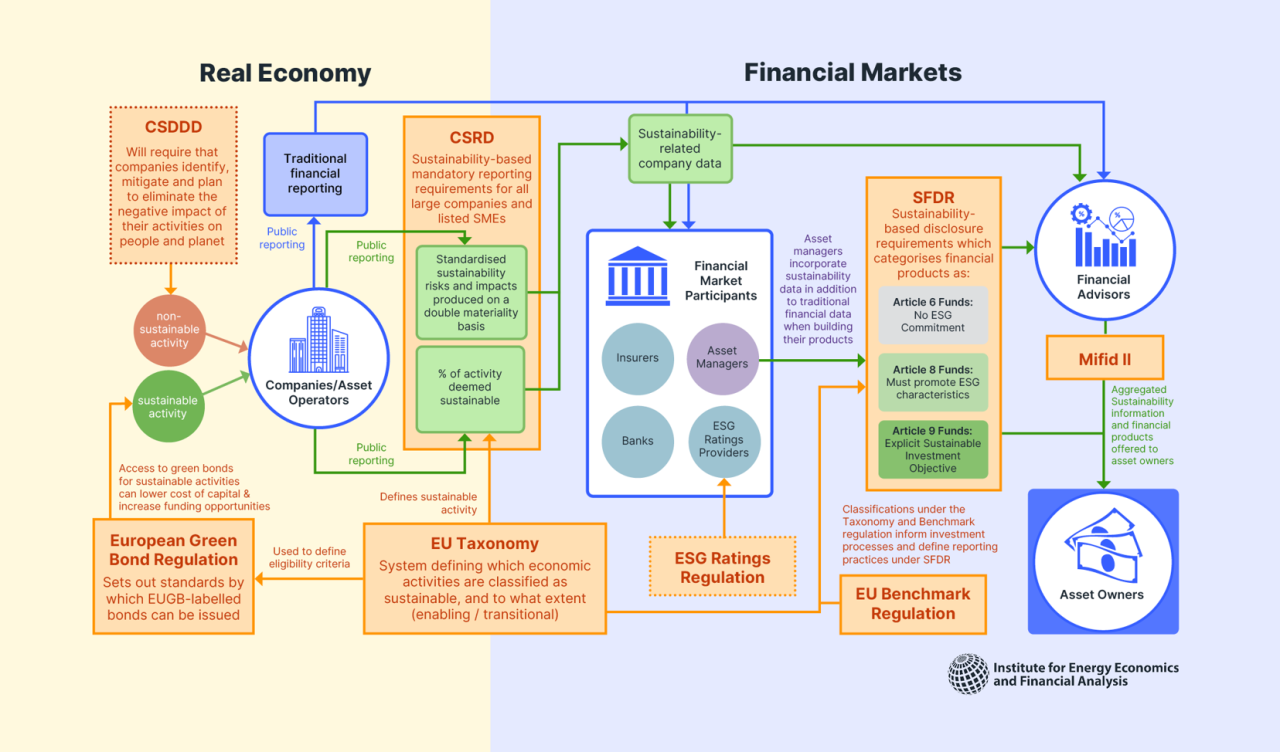
The EU’s sustainable finance framework was built upon the European Green Deal, the Paris Agreement, and the UN 2030 Agenda for Sustainable Development. The goal was to create a financial system that actively supports the transition to a low-carbon, resource-efficient, and circular economy . The framework comprised several interconnected pillars. The EU Taxonomy was established as a classification system to define what constitutes an environmentally sustainable economic activity, providing a “common language” for investors and companies . The CSRD was designed to mandate detailed sustainability reporting from large companies, ensuring that investors and stakeholders have access to reliable and comparable data on environmental, social, and governance (ESG) performance. The CSDDD was created to hold large companies accountable for their impact on human rights and the environment throughout their value chains. The SFDR, a disclosure regulation for financial market participants, aimed to increase transparency in the financial sector by requiring them to disclose how they integrate sustainability risks and impacts into their investment decisions and to classify their financial products based on their sustainability ambition . This comprehensive approach was intended to combat greenwashing, protect investors, and, most importantly, mobilize the massive private capital needed to fund the green transition.
The Omnibus: A Deregulatory Blow
The “Omnibus” simplification package, initiated by the European Commission in early 2025, marked a turning point. While the Commission argued that the package was intended to simplify rules and reduce administrative burdens without deregulating, the final outcome has been widely interpreted as a significant step backward . Environmental organizations like the WWF have been particularly vocal, describing the process as a “Pandora’s box” and a “race to the bottom” that has gutted core elements of the corporate sustainability framework . The criticism revolves not only around the final results but also the process itself, which was characterized by unnecessary urgency, a lack of transparency, and a dismissal of scientific evidence and stakeholder consultations . The European Ombudsman even concluded that the process was marked by “maladministration,” further undermining its credibility.
Dismantling the Pillars: A Detailed Look at the Failures
1. The Corporate Sustainability Reporting Directive (CSRD)
The CSRD was the cornerstone of the EU’s transparency agenda, aiming to provide investors with the data they needed to make informed decisions. One of the most damaging changes under the Omnibus package is the proposal to exclude more than 80% of companies from the CSRD’s scope . Instead of creating a proportionate reporting standard for smaller entities, the Commission effectively removed them from the framework entirely. This decision has several severe consequences.
First, it creates significant data gaps for investors, making it difficult to assess the sustainability performance of a vast portion of the economy . Second, it increases the burden on the remaining companies, as they may still be required to report on their full value chains, which include these now-exempt suppliers. Third, it restricts access to sustainable finance for the excluded companies, as they will lack the standardized data needed to attract green investment. This ultimately hampers economic prosperity by stifling the flow of capital towards smaller, potentially more innovative firms. Fourth, the two-year delay in implementing the law penalizes companies that have already invested heavily in building compliant reporting systems, signaling that their efforts are not valued or supported by the EU .
2. The Corporate Sustainability Due Diligence Directive (CSDDD)
The CSDDD was designed to be a landmark law that would hold companies accountable for environmental and human rights abuses in their global supply chains. The changes made to this directive are arguably the most damaging to the EU’s international standing. The most significant casualty is the mandatory requirement for companies to implement Climate Transition Plans . This requirement was a key tool for ensuring that companies actively contribute to the goals of the Paris Agreement. By making it optional, the EU is effectively allowing companies to continue business as usual without a credible plan to decarbonize. This opens the door to greenwashing, as companies can claim to be responsible without taking concrete, verifiable actions.
Furthermore, the scope of the CSDDD’s value chain has been severely limited, overlooking critical risks that exist in complex global supply chains . This reduces the entire due diligence exercise to a box-ticking activity that does little to address the real-world problems of forced labor, environmental destruction, and other abuses. The cumulative effect is to weaken the protection of human rights and the environment, effectively making the EU complicit in practices it had previously sought to eradicate.
3. The EU Taxonomy
The EU Taxonomy, intended to be a science-based guide for sustainable investment, has been undermined in several ways. The Omnibus package proposes changes that would effectively exclude more than 80% of businesses currently in its scope . This erosion of scope reduces the Taxonomy’s relevance and effectiveness, making it harder to compare sustainability performance and weakening incentives for companies to transition.
This credibility crisis was already brewing even before the Omnibus package. The General Court of the European Union’s 2025 ruling on the inclusion of nuclear energy and fossil gas in the Taxonomy is a case in point . By dismissing Austria’s challenge to this inclusion, the Court effectively granted a “blank cheque” to the Commission to bypass scientific standards and the proper legislative process. Critics argue that including fossil gas, even under strict conditions, lowers the bar for what is considered “green” and ignores the precautionary principle . The decision to not require a full lifecycle analysis means the framework fails to account for upstream impacts like methane leakage from gas extraction or the environmental damage caused by uranium mining. This has been described as a deeply politicized act that sidelines the role of renewable energy and undermines the EU’s climate credibility.
4. The Sustainable Finance Disclosure Regulation (SFDR)
The review of the SFDR, while intended to fix shortcomings, has been criticized for creating new weaknesses. The proposed revision removes a crucial entity-level reporting requirement, eliminating the obligation for financial institutions to disclose their Principal Adverse Impacts (PAIs) at the firm level . This leaves investors in the dark about the overall negative impact of their asset managers’ portfolios, making it nearly impossible to assess their true sustainability performance. The new product categories “ESG Basics,” “Transition,” and “Sustainable” are seen as too weak to provide meaningful guidance . The thresholds for categorization are too low (e.g., 70% minimum alignment for certain categories), and the criteria are too subjective, creating a high risk of greenwashing . The “Transition” category is particularly problematic. While the Commission’s proposal excludes fossil fuel expansion, the Council’s position, which is more aligned with industry lobbying, allows companies expanding fossil fuel production to qualify . This is a staggering failure that risks actively deceiving investors who believe their money supports the transition. It also fails to mobilize the necessary funds for the EU’s 2030 climate objectives, instead prolonging the region’s fossil fuel dependence. As ShareAction points out, this is “another dangerous step backwards for Europe’s sustainability agenda,” effectively throwing another crucial law under the deregulation bus .
The Consequences of Failure: A Detailed Examination
A. For the Environment
The primary failure of these revised rules is the severe damage they will cause to the environment. The weakened regulations fail to provide the necessary safeguards to protect nature and accelerate the transition to a low-carbon economy. The removal of mandatory climate transition plans (CSDDD) and the weakening of reporting requirements (CSRD) reduce the pressure on companies to decarbonize their operations and supply chains. The watering down of the Taxonomy, including the inclusion of fossil gas, sends a confusing signal to the market and potentially diverts capital away from genuinely green activities. The “transition” category in the SFDR, which could potentially fund fossil fuel expansion, directly contradicts the goal of aligning investments with the Paris Agreement. These changes collectively represent a significant step back from the ambitious climate and environmental goals the EU had set for itself.
B. For the Economy and Competitiveness
The irony of the “simplification” narrative is that these changes may ultimately harm, rather than help, the European economy. The sustainable finance framework was designed to unlock the massive investments needed for the green transition, which is essential for long-term economic prosperity. By creating regulatory uncertainty, the EU is discouraging long-term investment. Companies that have already invested in compliance are now seeing the goalposts move, creating a costly and unpredictable business environment . This undermines the very concept of a “level playing field” the EU sought to create.
Furthermore, by signaling that environmental and human rights issues are not a priority, the EU is risking its competitive edge in the global green economy. Other jurisdictions, like China and the US, are investing heavily in green technologies. The EU’s retreat from its leadership position on sustainability is a strategic error that could lead to a loss of market share in this rapidly growing sector. As the WWF noted, setting 1.5°C-aligned targets is both realistic and widely adopted by thousands of companies, including those in the EU, making the Commission’s choice to abandon this ambition a puzzling one .
C. For the EU’s Global Credibility
Perhaps the most profound consequence of this policy failure is the damage to the EU’s reputation as a global leader on environmental and social issues. The EU has spent years positioning itself as a champion of a rules-based, multilateral approach to tackling climate change. The decision to dismantle its own flagship laws for short-term political gain sends a devastating message to the rest of the world. It suggests that the EU’s green commitments are not long-term principles but are instead subject to the whims of political convenience. This “dangerous precedent” will be used by other countries as an excuse to weaken their own environmental regulations . It also undermines the EU’s ability to influence global standards and agreements, as it is effectively abdicating its role as a standard-setter. As the WWF aptly concluded, the final result demonstrates “the end of EU leadership on corporate sustainability” .
D. For Investors and Consumers
The weakening of the framework also harms the very people it was designed to protect: investors and consumers. The removal of entity-level reporting in the SFDR (Article 4) and the lowering of standards for product categories deprive investors of the reliable, comparable information they need to make informed decisions. This increases the risk of greenwashing, where financial products are marketed as sustainable without having a genuine positive impact. The “ESG basics” category, with its weak criteria, risks becoming a “permanent refuge” for products seeking an ESG label without meeting robust standards . As Frank Bold notes, the absence of mandatory standardized information on principal adverse impacts (PAIs) for all product categories prevents comparability and creates a “fragmented framework, which is prone to greenwashing” . Ultimately, this erodes trust in the financial system and undermines the ability of market forces to drive positive change.
The Path Forward: Restoring Integrity
The current trajectory is deeply concerning. The EU must urgently reconsider its course to restore the integrity and ambition of its sustainable finance framework. This requires a multi-pronged approach.
-
Reject the Omnibus Weakening: EU co-legislators (the Parliament and the Council) must take bold action to reject the most damaging elements of the Omnibus package and restore the ambition of the CSRD, CSDDD, and EU Taxonomy .
-
Anchor the SFDR in Science: The SFDR revision must be anchored in science, integrity, and best practice. The final text must exclude fossil fuel expansion from the “Transition” category, restore mandatory entity-level reporting, and establish robust, objective criteria for all product categories .
-
Commit to Evidence-Based Policymaking: The Commission must commit to a transparent and evidence-driven approach to policymaking, moving away from the rushed and opaque processes that have characterized the Omnibus package . This includes consulting all stakeholders, including civil society, and relying on scientific evidence rather than political convenience.
-
Prioritize Long-Term Prosperity: Policymakers must move beyond the false dichotomy between environmental ambition and economic prosperity. A well-designed and stable sustainable finance framework is essential for attracting the investments needed to create a competitive, resilient, and prosperous European economy. The EU cannot afford to sacrifice its long-term well-being for short-term political gains .
Conclusion
The EU’s sustainable finance framework, once a beacon of hope for a more sustainable future, is in crisis. The “simplification” process has been hijacked by a deregulatory agenda that has resulted in a significant weakening of key laws. This failure has profound consequences for the environment, the economy, and the EU’s global standing. It jeopardizes the green transition, creates regulatory uncertainty, and opens the door to greenwashing. The EU must immediately reverse course, reject the short-sighted approach of the Omnibus package, and restore the ambition and integrity of its sustainable finance rules. The stakes are too high to allow this race to the bottom to continue. The window of opportunity to mitigate the worst impacts of climate change is closing, and the EU’s actions, or lack thereof, will have consequences that echo for generations. It is time for the EU to remember its commitments, listen to the science, and once again lead the way towards a sustainable, just, and prosperous future.