
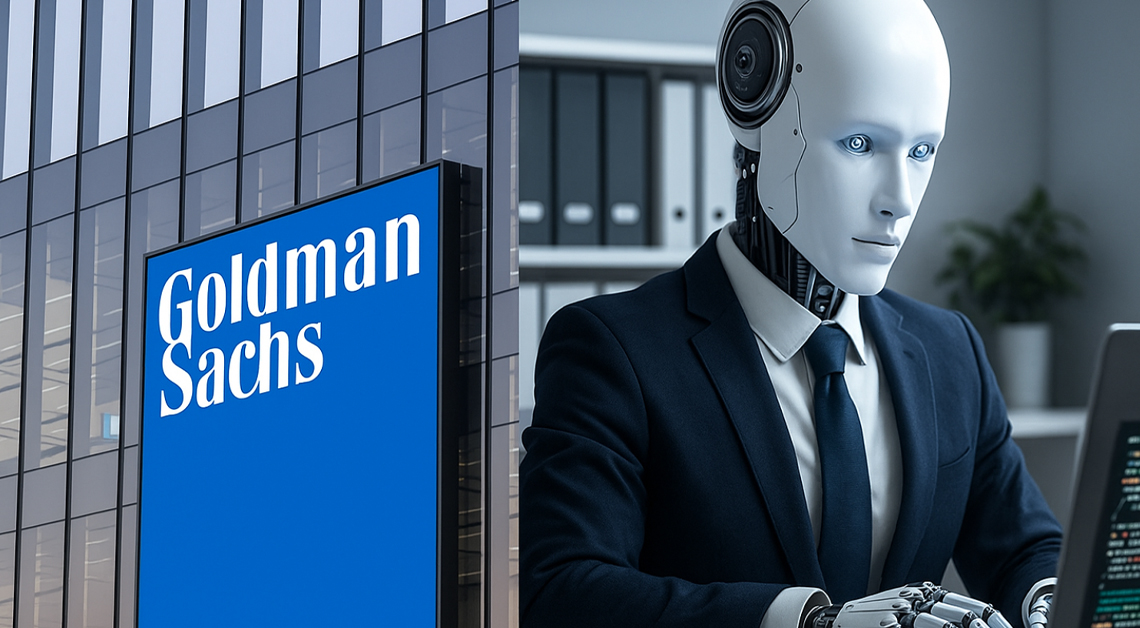
In the high-stakes world of global finance, where milliseconds can mean millions and regulatory compliance is paramount, a profound transformation is underway. It’s not just another software upgrade or a shift in market strategy. It is the dawn of the “hybrid workforce,” a term coined by Goldman Sachs’ Chief Information Officer, Marco Argenti, to describe a new reality where artificial intelligence agents are no longer just tools but are treated as digital co-workers. Wall Street’s titan is not merely experimenting with generative AI; it is embedding autonomous agents into the very fabric of its operations, tackling complex accounting, compliance, and software engineering tasks, thereby redefining productivity and operational efficiency in the 21st century.
This strategic pivot comes as Goldman Sachs, under the leadership of CEO David Solomon, navigates a post-Apple Card era, refocusing on its core strengths in Global Banking & Markets and Asset & Wealth Management. The dissolution of the consumer banking partnership was costly, but it freed up capital and, more importantly, set the stage for an aggressive reinvestment in technology that promises to revolutionize how the firm operates. The goal is clear: to “constrain headcount growth” while supercharging productivity and scaling operations in a capital-light manner, a move that signals a broader industry shift from AI experimentation to production-grade, agentic systems.
The Co-Workers Behind the Firewall
The technical backbone of this new era is the GS AI Assistant, a sophisticated internal platform that is far more than a simple chatbot. It is a secure, multi-model environment hosted entirely behind the firm’s firewall, designed to give all 46,000+ employees access to the “latest and greatest” large language models (LLMs) while maintaining stringent security and compliance standards. This approach is not just about access; it is about control. The architecture includes an internal gateway that performs prompt filtering, data anonymization, and policy checks before any query reaches a vendor model, and maintains a detailed audit trail of all AI interactions, ensuring compliance with regulatory rules and preventing any sensitive information from leaking out.
The platform allows employees to interact with a curated suite of models, including OpenAI’s GPT-4, Google’s Gemini, Meta’s Llama, and Anthropic’s Claude, choosing the best model for their specific task. This multi-model orchestration, combined with retrieval-augmented generation (RAG), ensures that responses are grounded in Goldman’s proprietary and up-to-date data, providing answers that are accurate and contextually relevant. This powerful combination allows the GS AI Assistant to move beyond generic tasks and adapt to the specific needs of different departments, from investment bankers and wealth managers to software engineers and compliance officers.
A Spectrum of Automation: From Copilot to Autonomous Agent
Goldman Sachs’ AI strategy is not monolithic; it is a layered approach that spans a spectrum of automation. On one end are “copilot” tools that augment human capabilities, and on the other are autonomous “agentic” systems that operate as digital employees.
The Assistant as a Force Multiplier
The GS AI Assistant is designed to be a powerful productivity tool, streamlining a wide array of tedious and time-consuming tasks. It is a force multiplier for the firm’s human workforce, allowing them to focus on higher-value, strategic activities. Here are some of the key functions of the GS AI Assistant that are already in use across the firm:
-
Document Summarization and Drafting: The assistant can rapidly summarize complex documents like regulatory filings, earnings reports, and legal contracts, saving professionals hours of reading time. It can also draft initial versions of research notes, pitchbooks, and client communications, providing a strong starting point that can be refined by the human expert.
-
Data Analysis and Coding: It is used to accelerate data-heavy tasks and to generate, debug, and translate code, significantly boosting the productivity of software developers. This has reportedly led to a 20% increase in coding speed and a 15% reduction in post-release bugs.
-
Research and Translation: It can query internal databases to retrieve information from past deal histories or compliance manuals. It also enables wealth managers to translate research documents into multiple languages for international clients at the click of a button.
-
Client Query Resolution: The tool can quickly surface answers to common client questions by cross-referencing a vast internal knowledge base, enabling faster and more informed client service.
The widespread adoption of this tool underscores its success. Reports indicate that over 50% of Goldman’s employees are already using the GS AI Assistant, and executives are targeting 100% adoption by 2026. This is not a top-down mandate; it is a bottom-up embrace of a technology that demonstrably makes people’s jobs easier and more efficient.
The Rise of the Digital Co-Worker
While the GS AI Assistant is a powerful “copilot,” the firm’s most audacious move is the deployment of autonomous “digital co-workers” that can execute tasks on behalf of employees. This is the realm of “agentic AI,” where the system is given a goal and can independently determine the steps necessary to achieve it. The two most prominent examples are the deployment of Devin, an AI software engineer, and the creation of autonomous agents for accounting and compliance, built on Anthropic’s Claude model.
Devin: The AI Software Engineer
Goldman Sachs became the first major financial institution to pilot Devin, an autonomous AI software engineer developed by Cognition Labs. Unlike earlier tools like GitHub Copilot, which offer suggestions to a human programmer, Devin is capable of autonomously managing entire software lifecycles. It can take a coding project from start to finish, writing code, debugging errors, and deploying applications with minimal human intervention.
Currently, Devin is being utilized by the bank’s 12,000-person developer team. The results have been remarkable. While previous AI coding tools provided a 20% productivity boost, Goldman reports that Devin has driven a 3x to 4x increase in developer output. This is a game-changer, allowing the bank to modernize its legacy systems, clear out technical debt, and accelerate the delivery of new applications at a pace previously unimaginable. Developers are not being replaced, but their roles are evolving. They are becoming strategic thinkers, problem describers, and supervisors of their AI colleagues, focusing on complex, creative, and high-level tasks while Devin handles the “grunt work”.
Anthropic’s Claude: The Accounting and Compliance Agent
The success with Devin revealed a crucial insight: the ability to reason through complex, step-by-step problems and apply logic, a skill Goldman’s CIO Marco Argenti attributes to Claude’s “reasoning ability,” could be applied far beyond coding. This led to a six-month collaboration with Anthropic, where engineers were embedded at Goldman to co-develop autonomous agents for two specific, high-volume, and complex back-office functions: accounting/trade reconciliation and client vetting/onboarding.
-
Trade Reconciliation and Accounting: In the world of investment banking, thousands, if not millions, of trades are executed daily. Matching these trades with counterparties, ensuring accuracy, and resolving discrepancies (trade reconciliation) is a massive, data-intensive process that was previously difficult to fully automate due to its complexity. The new AI agents can handle this process autonomously, significantly collapsing the time needed to resolve these issues and potentially reducing the risk of costly errors.
-
Client Vetting and Onboarding (KYC/AML): “Know Your Customer” (KYC) and anti-money laundering (AML) compliance are regulatory necessities that require vetting new clients, which is a time-consuming manual process. The AI agents can be deployed to parse vast amounts of data from various sources to accelerate and enhance the client vetting and onboarding process, making it faster and more efficient.
This deployment is not just about cost-cutting; it’s about fundamentally reimagining how compliance, which is a highly “scaled, complex, and process-intensive profession,” operates. The goal is to “do things faster,” which in turn “translates to a better client experience and more business”. The success in these areas has surprised executives, reinforcing their belief that AI can handle complex, rules-based work well beyond the realm of software development.
One Goldman Sachs 3.0: An AI-Driven Future
This firmwide AI deployment is the centerpiece of a broader strategic transformation known as “One Goldman Sachs 3.0” (OneGS 3.0). Launched in 2026, OneGS 3.0 is a multi-year initiative designed to embed AI as a core operating capability, not just a standalone solution. The initiative aims to drive stronger operating leverage, improve efficiency, and elevate client services by simplifying processes and modernizing the firm’s infrastructure.
This is a move to reshape the revenue mix, pushing towards higher-fee, data-driven businesses while reducing reliance on balance-sheet-intensive activities. The firm is even reorganizing its Technology, Media, and Telecom (TMT) investment banking division to capitalize on the rising demand for AI-related deals, focusing on areas like digital infrastructure, semiconductors, and enterprise software. By sharpening its focus on AI, Goldman is not just an adopter of the technology; it is positioning itself as a key architect of the new AI economy.
The Human Element: The Future of Work at Goldman Sachs
The introduction of “digital co-workers” inevitably raises questions about the future of human employment. Are these AI agents harbingers of mass layoffs? Goldman Sachs executives are keen to frame this as a story of augmentation, not replacement. President and COO John Waldron has been at the forefront of this messaging, describing Goldman Sachs as a “human assembly line” where processes are now becoming “more digitized” and digital agents are the firm’s “robots”. He firmly rejects the idea of a “march of the machines,” instead arguing that the increased efficiency will lead to a more “resilient and scalable” firm where overall employee numbers remain largely stable.
CIO Marco Argenti echoes this sentiment, emphasizing that AI will allow the firm to “do things faster,” leading to more business and a better client experience, not necessarily fewer jobs. While acknowledging it is “premature” to predict job losses, he notes that the firm could potentially cut out third-party providers as the technology matures, freeing up capacity. The shift will create new roles in engineering and technology and is expected to reduce routine tasks for junior bankers, such as summarizing earnings calls and preparing pitchbooks, allowing them to engage in more valuable, client-facing work. The vision is a “hybrid workforce” where “people and AIs work side by side,” with humans taking on the roles of supervisors, strategic thinkers, and creative problem solvers.
Implications and a Roadmap for the Industry
Goldman Sachs’ aggressive AI adoption is a landmark case study for the financial industry and beyond. It signals a definitive shift from AI as a proof-of-concept to AI as a core driver of business strategy. For other financial institutions, particularly in regions like the Middle East pursuing ambitious digital transformation plans like Saudi Vision 2030, it provides a practical roadmap for deploying AI in compliance-heavy environments.
The results are already quantifiable, with record Q1 2026 earnings and a significant stock surge attributed in part to the market’s confidence in this new direction. The firm is proving that it is possible to harness the power of AI within a tightly regulated environment by building a secure, compliant, and robust internal architecture. The focus on production-grade “agentic” systems rather than simple chatbots is a crucial lesson; the goal is not just to talk to an AI, but to have it actively complete tasks.
In conclusion, Goldman Sachs is not just deploying AI; it is being transformed by it. Through the roll-out of the GS AI Assistant, the deployment of autonomous agents like Devin and the Anthropic co-workers for accounting and compliance, and the overarching strategic initiative of OneGS 3.0, the firm is building the world’s most advanced “hybrid workforce.” This is a bold reimagining of the modern enterprise, one where the synergy between human expertise and artificial intelligence is the ultimate competitive advantage, setting a new standard for Wall Street and the global economy. The question is no longer if AI will change the world of finance, but how quickly the rest of the world will follow Goldman Sachs’ lead into the future of work.