

In the ever-evolving landscape of the global economy, the 2.7% growth forecast for 2026 serves as a pivotal indicator of the world’s economic health and trajectory. As we navigate through a complex web of geopolitical tensions, technological revolutions, and post-pandemic adjustments, understanding the nuances behind this figure becomes essential for policymakers, investors, and business leaders alike. This comprehensive analysis delves deep into the factors shaping the 2.7% global growth projection, examining the divergent forecasts from major international institutions, the underlying drivers of resilience, and the significant risks that could derail this modest expansion.
The Forecast Landscape: A Tale of Three Institutions
Understanding the 2.7% Projection
The figure of 2.7% represents the United Nations’ global growth forecast for 2026, serving as a baseline for understanding the world economic outlook . This projection positions global growth at a moderate pace, reflecting both the lingering impacts of previous disruptions and the emergence of new economic dynamics. While this figure might appear modest compared to pre-pandemic trends, it represents a careful calibration of numerous competing factors that influence the world economy.
Divergent Perspectives from Major Institutions
The global growth landscape features several distinct projections from leading international organizations:
A. The International Monetary Fund (IMF) projects global growth at 3.3% for 2026, representing an upward revision of 0.2 percentage points from previous estimates . This more optimistic outlook reflects stronger-than-expected performance in key economies, particularly the United States and the ASEAN region.
B. The United Nations maintains a more conservative estimate at 2.7%, acknowledging the significant headwinds facing the global economy, including geopolitical tensions and supply chain disruptions .
C. The World Bank forecasts growth at 2.6%, closely aligned with the UN’s projection, and also representing an upward revision from mid-2025 estimates .
The divergence between these forecasts highlights the inherent uncertainty in economic projections and the varying methodologies employed by different institutions. The IMF’s relatively more optimistic stance reflects their assessment of resilience in advanced economies, while the UN and World Bank place greater emphasis on downside risks.
The Resilience Factor: Understanding Global Economic Strength
Technology Investment as a Growth Engine
One of the most significant drivers of economic resilience has been robust investment in artificial intelligence and related technologies . The AI boom has catalyzed substantial capital expenditure across multiple sectors, creating a new growth paradigm that has helped offset traditional economic headwinds. This technological revolution has manifested in several key ways:
A. Data center construction and expansion has surged, particularly in the United States, driving significant investment in infrastructure .
B. Semiconductor purchases have increased dramatically, supporting both domestic manufacturing and international trade in AI-enabling products .
C. AI-related investment contributed approximately one percentage point to United States real GDP growth in 2025, demonstrating the tangible economic impact of this technological revolution .
Supply Chain Adaptation and Reconfiguration
The global economy has demonstrated remarkable adaptability in response to trade disruptions and geopolitical tensions. The reconfiguration of supply chains across Asia represents one of the most significant structural shifts in recent years . This transformation has been driven by several factors:
A. Chinese foreign direct investment in ASEAN nations has more than tripled, rising from $10 billion in 2017 to over $34 billion in 2024 .
B. US importers have employed mitigation strategies, including front-loading goods before tariff implementation and rerouting Chinese products through neighboring regions .
C. The regional reconfiguration has helped maintain the ASEAN market share of US imports at approximately 60%, demonstrating the resilience of Asian supply chains .
Financial Conditions and Monetary Policy
Accommodative financial conditions have provided crucial support to global growth . Key aspects of this supportive environment include:
A. Monetary policy easing in most major economies has helped maintain economic momentum, with central banks having lowered interest rates from restrictive to near-neutral levels .
B. Global financial conditions eased throughout 2025, driven by strong risk appetite fueled by AI optimism .
C. Corporate credit spreads continued to narrow in major jurisdictions, with robust primary issuance across the ratings spectrum .
The Dark Clouds: Significant Risks Facing the Global Economy
Geopolitical Tensions and Regional Conflicts
The Middle East conflict has emerged as the dominant force shaping the global economic outlook, creating significant disruptions to energy markets and supply chains . The implications of this geopolitical crisis are far-reaching:
A. The closure of the Strait of Hormuz has created a historic supply disruption, cutting crude oil flow by over 10 million barrels per day, equivalent to 13% of normal supply .
B. More than 40 energy assets across nine Middle Eastern countries have been severely damaged, with full recovery of some facilities expected to take up to five years .
C. The impact extends beyond oil and gas, affecting fertilizers, petrochemicals, plastics, and helium supplies .
Inflation Resurgence and Policy Dilemmas
The conflict has halted the global disinflation trend that had been underway since 2023 . Key inflation dynamics include:
A. Global inflation is now expected to reach 3.9% in 2026, up from 3.1% projected in January .
B. In developed economies, inflation is forecast to rise from 2.6% in 2025 to 2.9% in 2026 .
C. Developing economies face a sharper uptick, with inflation projected to accelerate from 4.2% to 5.2% .
AI Bubble Concerns and Financial Vulnerabilities
While AI investment has been a significant growth driver, concerns about a potential bubble have emerged . Key considerations include:
A. If evidence fails to build that AI investment is boosting productivity at firms, fears about an AI bubble could increase .
B. Softening labor markets in several countries could impact consumer spending .
C. Rising government bond yields in the US and elsewhere would likely weigh on global financial markets, increase debt-servicing costs, and hurt economic growth .
Regional Divergence: A World of Uneven Growth
The United States and Advanced Economies
The US economy has demonstrated particular resilience, accounting for nearly two-thirds of the upward revision in global growth projections . Key characteristics of this resilience include:
A. Strong performance in the United States, helped by supportive financial conditions and the AI boom .
B. More sluggish growth anticipated in the UK and eurozone .
C. The US is expected to once again be the strongest performer among major advanced economies in 2026 .
Emerging Market and Developing Economies
Emerging market and developing economies continue to serve as an important global growth engine, with distinct regional dynamics:
A. The IMF projects emerging market and developing economies to grow above 4.0% in 2026-2027 .
B. India is expected to once again be the world’s fastest-growing economy, showing resilience against US tariffs .
C. China’s growth is expected to moderate in 2026 while remaining faster than the global average .
The Disproportionate Impact on Developing Countries
The global crisis has intensified strains across developing economies . Key challenges include:
A. Rising borrowing costs and renewed capital flow pressures risk deepening debt vulnerabilities .
B. Food and energy prices risk pushing millions more into food insecurity and deeper poverty .
C. Low-income families, who devote a larger share of their spending to food and energy, are bearing the heaviest burden .
Sectoral Implications and Economic Consequences
Energy Markets and Commodity Prices
The energy sector has been particularly affected by current geopolitical tensions, with cascading effects throughout the global economy:
A. Disruptions to shipments through the Strait of Hormuz have triggered a sharp rise in energy prices .
B. Higher costs for fertilizers and other critical industrial inputs are feeding into broader inflationary pressures .
C. Physical damage to energy infrastructure means supply losses are likely to persist even after the end of the conflict .
Supply Chain Vulnerabilities and Critical Inputs
The concentration of critical supply chain components in specific regions has exposed significant vulnerabilities:
A. Helium supply disruption has impacted Asian economies that rely heavily on Qatar for supply .
B. Equipment bottlenecks compound problems, with producers of gas turbines carrying order backlogs of three to five years .
C. Fertilizer shortages could have persistent effects on global food supply, as missed planting windows cannot be recovered .
Financial Markets and Investment Patterns
Financial markets have responded to these developments with significant repricing:
A. Investor expectations for rate cuts have evaporated, with 30-year US bond yields breaching 5% again .
B. Markets in the UK have priced as many as three rate hikes this year from the Bank of England .
C. Rising equity values, whose ratio to income has more than doubled since 2010, have supported household consumption through wealth effects .
The Future Outlook: Scenarios and Possibilities

A. The Time-Limited Disruption Scenario
In this scenario, disruptions are assumed to remain relatively short-lived, with gradually easing energy prices . Key features include:
-
Global economic growth is projected to slow from 3.4% in 2025 to 2.8% in 2026 before recovering to 3.1% in 2027 .
-
Annual consumer price inflation in G20 countries is expected to rise to 4.0% in 2026 .
-
Growth is set to slow modestly in North America and Europe before a tentative recovery .
B. The Prolonged Disruption Scenario
In this more pessimistic scenario, broader disruptions last well into 2027, with much more long-lasting negative consequences . Key projections include:
-
Global growth could slow significantly to just 2.1% in 2026 and 1.8% in 2027 .
-
Some economies could be pushed into or close to recession .
-
Global inflation would rise by 0.4 percentage points in 2026 and 1.3 percentage points in 2027 .
C. The Alternative Growth Path
The World Bank projects global growth to remain broadly steady, easing to 2.6% in 2026 before ticking up to 2.7% in 2027 . This scenario suggests:
-
The global economy will maintain moderate but steady expansion.
-
The 2020s will likely be the weakest decade for global growth since the 1960s .
-
Low-income countries could reach approximately 5.6% annual growth .
Policy Implications and Strategic Responses
Monetary Policy Challenges
Central banks face particularly difficult decisions in the current environment :
A. Temporarily higher headline inflation resulting from energy price shocks can be looked through provided long-term inflation expectations remain well-anchored .
B. However, a policy response may become necessary if price pressures broaden or if growth weakens significantly .
C. Central banks need to remain vigilant and attentive to shifts in the balance of risks around economic and financial developments .
Fiscal Policy and Support Measures
Governments have responded swiftly with support measures, but targeting remains a challenge :
A. Many governments have provided relief to households and firms through broad-based measures such as tax reductions and price caps .
B. These measures tend to weaken incentives to reduce energy use and can prove costly .
C. Support should be increasingly targeted to vulnerable households and firms to contain fiscal costs .
The Path to Resilience
Strengthening economic resilience requires comprehensive structural reforms :
A. Diversifying energy sources, technologies, and supply chains reduces reliance on single points of failure .
B. Improving energy efficiency and accelerating the transition to renewables strengthens long-term economic sustainability .
C. Structural reforms in factor and product markets can help countries convert global uncertainty into opportunity .
Implications for Different Stakeholders
For Policymakers
The current environment demands careful navigation between competing priorities:
-
Balancing inflation control with growth support requires nuanced policy approaches .
-
Maintaining fiscal sustainability while providing necessary relief measures requires disciplined targeting .
-
International coordination of strategic energy stocks can help mitigate supply crunch effects .
For Investors and Businesses
The uncertain environment presents both challenges and opportunities:
-
The AI sector offers significant growth potential, though bubble risks warrant caution .
-
Supply chain resilience has become a competitive advantage, creating opportunities for businesses that adapt effectively .
-
Regional divergence suggests that diversification across geographies may help manage risk .
For Developing Countries
The disproportionate impact on developing economies demands particular attention:
-
Rising borrowing costs and debt vulnerabilities require careful management .
-
Food security and poverty concerns need urgent policy responses .
-
The crisis reinforces the strategic case for renewable energy investments .
Conclusion
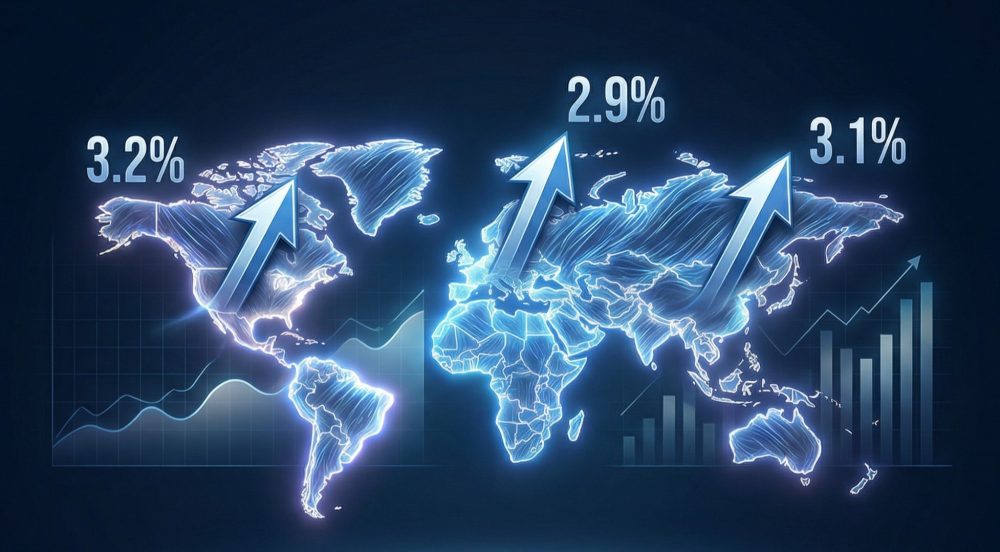
The global growth forecast of 2.7% for 2026 represents a crucial benchmark in understanding the current state and trajectory of the world economy. While this figure suggests continued expansion, it masks significant regional divergence and underlying vulnerabilities that could derail growth prospects.
The resilience demonstrated by the global economy, particularly through AI investment and supply chain adaptation, has been remarkable . However, geopolitical tensions, inflation pressures, and financial vulnerabilities pose substantial risks that require careful management .
As we navigate this complex environment, the path forward requires balanced policy approaches that support growth while maintaining stability and resilience. The choices made by policymakers, investors, and business leaders in the coming months will significantly shape whether the world achieves the moderate growth projected or faces more challenging economic conditions.
The global economy stands at a critical juncture, where resilience and vulnerability coexist in unusual tension. Understanding this dynamic and responding effectively will be essential for navigating the uncertain road ahead.